
1935 Penny Color Guide: Brown, Red-Brown, or Red — What Pays More?
1935 Wheat penny value can vary sharply, even when two coins share the same numeric grade. The difference often comes down to color.
The 1935 cent is not rare. It was struck in large numbers and widely circulated. Yet one fully Red example can sell for several times more than a Brown coin in the same Mint State grade.
Why does surface color change the price so much?
Basic Characteristics of the 1935 Wheat Cent
Before discussing color premiums, the coin itself must be clear:
Feature | Specification |
Series | Lincoln Wheat (1909–1958) |
Composition | 95% copper, 5% tin, and zinc |
Weight | 3.11 g |
Diameter | 19.05 mm |
Edge | Plain |
Designer | Victor D. Brenner |
The 1935 cent is a standard pre-war copper issue. No special design changes occurred that year. All color differences result from surface preservation, not from mint variation.
Why Copper Changes Color
The 1935 cent contains 95% copper. Copper is reactive. The moment it leaves the dies, oxidation begins.
Freshly struck copper appears bright red. Over time, exposure to oxygen, humidity, sulfur, and skin oils changes the surface tone. The red shifts to a darker shade. Eventually, it becomes fully brown.
This process is natural. It does not mean damage. It reflects a chemical change.
Storage conditions control the speed. Coins kept in dry, inert environments retain red longer. Coins stored in paper rolls, cardboard albums, or humid air tone faster.
Color is chemistry. It shows how well the surface survived.
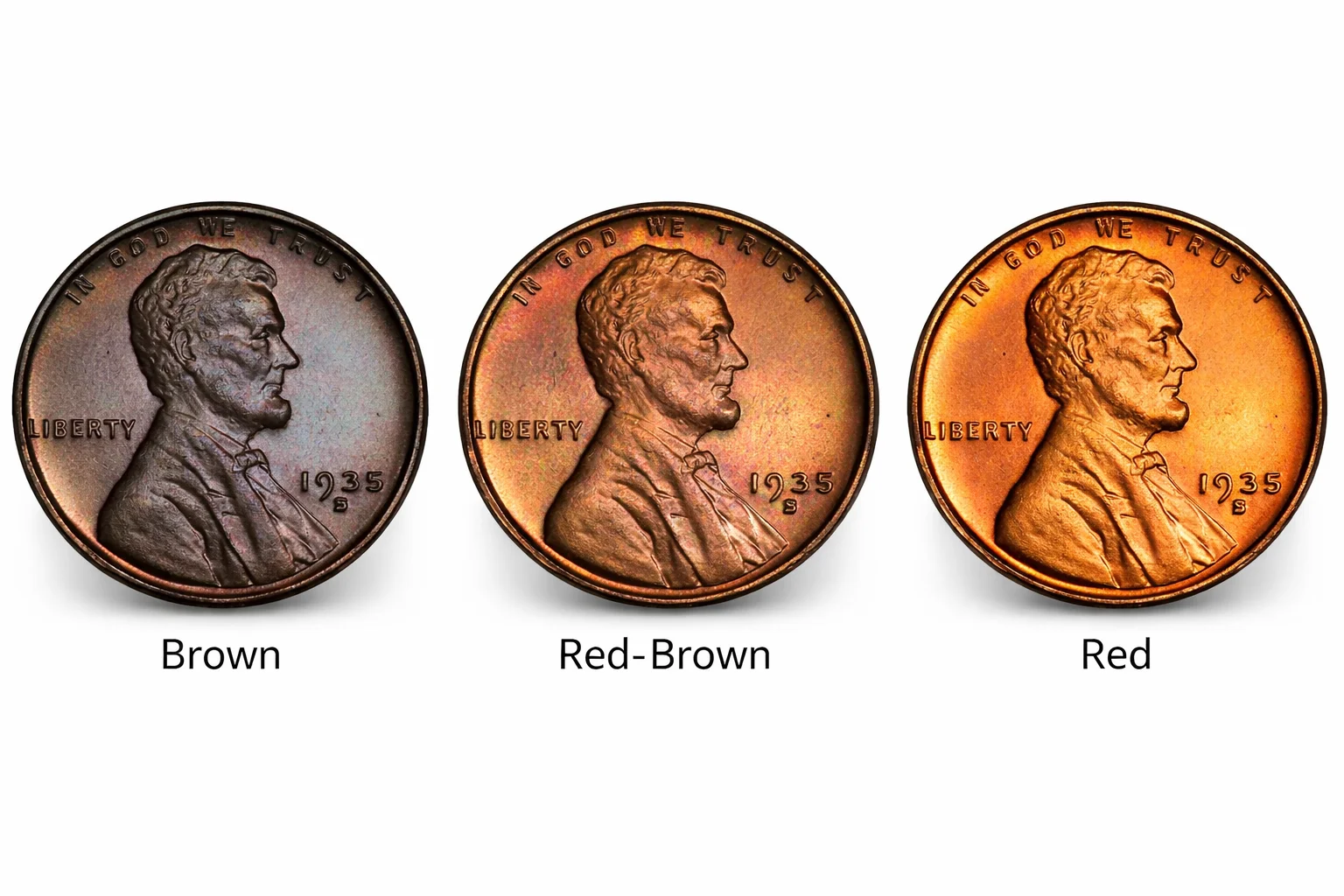
The Three Official Color Designations
Third-party grading services recognize three color categories for copper coins:
Brown (BN)
Red-Brown (RB)
Red (RD)
These labels appear on certified holders. They influence value directly.
Brown (BN)
Brown cents show full oxidation. Little to no original red remains. Most pre-war Wheat cents fall into this category.
In circulated grades, nearly all 1935 cents are brown. In Mint State, Brown examples remain common.
Brown is stable. It does not attract the strongest premium.
Red-Brown (RB)
Red-Brown coins retain partial original mint color. Red remains visible in protected areas. The rest of the surface shows toning.
RB coins sit between affordability and higher premiums. They often appeal to collectors who want eye appeal without paying full Red prices.
The transition from RB to RD can change the value significantly.
Red (RD)
Red coins preserve most of their original mint color. Grading services apply strict standards. Minor toning may still qualify, but the dominant appearance must remain red.
True Red cents from 1935 are harder to find than Brown ones. Time works against copper. Even coins stored carefully can tone.
Red designation brings the highest premiums, especially in high Mint State.
Price Comparison: Same Grade, Different Color
The strongest proof of color impact appears when comparing identical grades.
Approximate ranges for 1935 Mint State examples:
Grade | Brown (BN) | Red-Brown (RB) | Red (RD) |
MS63 | $10–20 | $18–35 | $35–70 |
MS65 | $20–40 | $45–90 | $90–175 |
MS66 | $40–80 | $110–225 | $225–450 |
*Prices may change with time, so always double-check the results.
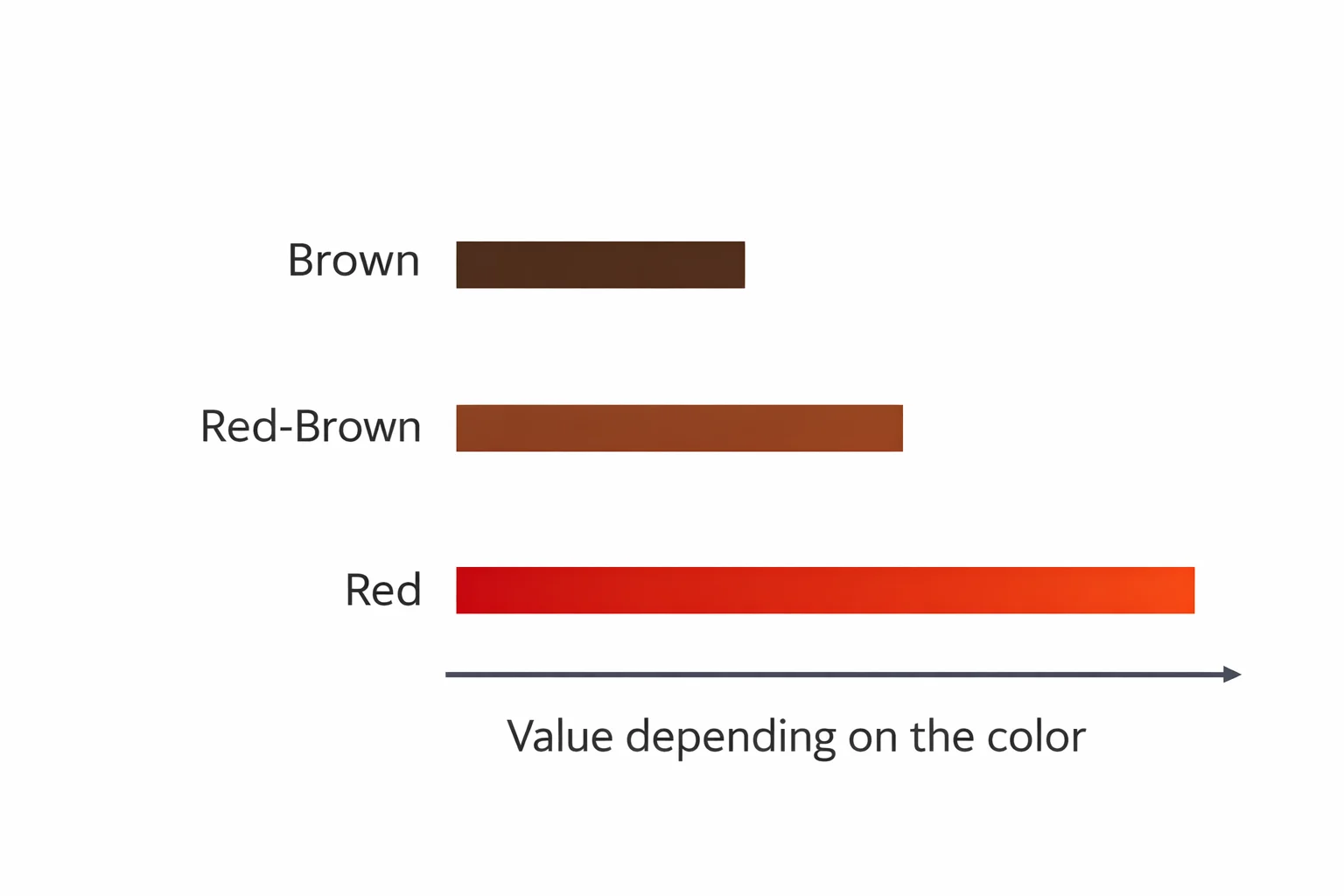
At the same numeric level, Red coins often sell for two to four times more than Brown coins. In MS66 and higher, the gap becomes more noticeable, especially for coins with strong original luster and eye appeal.
For this date, four-figure prices typically begin at MS67 RD, where true full-red preservation becomes significantly rarer. The date remains unchanged. The surface drives the premium.
Auction Records: Real Market Evidence
Market results confirm the difference.
For example:
Auction Record: $62 for MS64BN on eBay
Auction Record: $120 for MS66RB on eBay
Auction Record: $23,000 for MS67 RD at Bowers & Merena
The jump from Brown to high-grade Red becomes dramatic at top levels. The MS67 sale reflects extreme preservation. Very few 1935 cents survive in full Red at that level.
Auction history shows that color combined with grade determines final price.
Why Red Coins Are Harder to Find
Copper does not stay bright forever. Oxidation continues slowly even in storage.
Several factors reduce Red survival:
Circulation wear
Contact with paper rolls
Sulfur from cardboard albums
Finger oils
Humid environments
Many 1935 cents were handled frequently. Others were saved but not stored properly. Over the decades, surfaces have toned.
As a result, true Red examples in strong Mint State are limited. Scarcity in preservation supports higher prices.
Original Red vs Artificial Brightness
Not every bright coin qualifies as original Red.
Collectors must separate natural surfaces from altered ones.
Original Red surfaces show:
Even tone across fields and devices
Strong cartwheel luster under rotation
Smooth texture under magnification
Artificially cleaned coins often display:
Excessive brightness
Hairline scratches
Uneven color patches
Dull fields when tilted
Cleaning removes metal. It reduces long-term value. Grading services may lower the designation or refuse straight grading.
Surface originality matters more than brightness.
Does Mint Mark Influence Color Survival?
The 1935 cent was struck at Philadelphia, Denver, and San Francisco. All three mints used the same copper alloy.
There is no confirmed evidence that one mint preserved Red surfaces better than another. Survival depends on post-mint storage, not production differences.
In high grades, 1935-D and 1935-S Red coins may appear scarcer simply due to lower original mintage. However, color survival follows environmental factors, not mint intent.
Color premiums apply across all three mint marks.
Market Behavior: What Actually Pays More?
In circulated grades, color differences matter less. Most coins show wear and full brown surfaces. Price separation remains modest.
In Mint State, color begins to influence premiums.
In MS63, Red coins show a noticeable advantage.
In MS65, the premium becomes strong.
In MS66 and above, Red dominates pricing. Brown examples rarely reach similar levels.
Registry collectors compete for top-grade Red coins. Population reports show a limited supply in MS66 RD and higher.
The market rewards surface preservation.
Color and Eye Appeal
Color alone does not guarantee high value. Even Red coins must show strong eye appeal.
Spotting, uneven toning, or surface stains reduce desirability.
Balanced color with smooth luster attracts stronger bids. Uniform surfaces reflect careful storage.
Collectors examine coins under neutral light. Rotation reveals the cartwheel effect. Breaks in luster indicate friction.
Color classification and eye appeal work together.
Comparing Brown, Red-Brown, and Red in Practical Terms
Brown coins remain accessible. They serve as affordable examples for set builders.
Red-Brown offers balance. It preserves some original color without reaching extreme premiums.
Red commands the highest demand in Mint State. At higher grades, the difference grows exponentially.
The transition from BN to RD does not change the design. It changes survival quality.
Final Answer: What Pays More?
For a 1935 Wheat cent, the hierarchy is clear:
Brown: lowest premium in Mint State
Red-Brown: moderate premium
Red: highest premium
At MS65 and above, color can multiply the value several times. At MS66 and beyond, Red examples become scarce and auction-driven.
The date remains the same. The metal remains the same. The color determines the price.
For the 1935 cent, surface preservation defines value.